Introduction
It’s hard to predict when a fire will start in a home, but fire sprinkler systems can make the difference between a tiny problem and a big loss. That’s where NFPA 13D comes in. The National Fire Protection Association (NFPA) established this fire protection standard. It tells people how to plan and put in fire sprinkler systems in residences with one or two households. NFPA 13D is not like NFPA 13 and 13R for businesses because it only deals with life safety and not property protection. It is also a more efficient and cost-effective way to do things.
The basic purpose of NFPA 13D systems is to put out fires quickly enough for people to get out, not necessarily to save the building. This makes them easier to install because they need fewer sprinkler heads, less water, and less areas to cover. There may not be any closets, bathrooms, or attics at all. These systems can also be connected to a home’s water supply, which saves money on costly improvements to the infrastructure.
People who build, hire others to build, or even own a home need to know NFPA 13D. When installed and cared for properly, these systems offer solid protection for a variety of reasons, including meeting building codes, getting lower insurance rates, and making things safer. We discuss the most significant aspects of NFPA 13D fire sprinkler systems, what they need in terms of water supply, and the best ways to use them in this TechNote.
What is NFPA 13D?
Residential fire sprinklers are the unsung heroes who keep our homes and families safe. NFPA 13D is a standard that specifies the requirements for designing and installing fire sprinkler systems in residential properties. What is its major purpose? To save lives by extinguishing fires early enough for residents to flee.
Unlike commercial systems protected by NFPA 13 or NFPA 13R, systems constructed under NFPA 13D are frequently simpler and less costly:
-
- Certain small closets, baths, and attics do not require coverage.
- The system is designed to run fewer sprinklers at a time, usually just one or two.
- Water supply standards are less stringent, sometimes relying on an existing home water source.
When Are Sprinklers Required?
Sprinkler standards differ by jurisdiction, however several locations have included portions of the 13D standard into their construction codes:
-
- Sprinklers may be required for new residential building in accordance with zoning or density laws.
- Some insurance companies provide discounts for properties protected by NFPA 13D-compliant equipment.
Why does it Matters?
According to the National Fire Protection Association, having sprinklers and working smoke alarms reduces the danger of dying in a home fire by 80%. These systems turn on automatically and can extinguish or control flames long before firemen arrive.
Installing a residential fire sprinkler system in accordance with NFPA 13D requires a set of well-defined processes to ensure safety, compliance, and functionality. Here is a condensed outline of the main phases:
1. Planning and Design.
-
- Consider the property layout: Determine all rooms, ceiling kinds, and any impediments.
- Determine the coverage areas: NFPA 13D provides for exceptions, like small closets or bathrooms, so plan appropriately.
- Hydraulic Calculations: Ensure that the system can provide appropriate water flow and pressure.
- Select the components: Choose sprinklers, pipework, valves, and fittings that adhere to NFPA 13D requirements.
2. Permits and Submittals
-
- Submit proposals to the local authority with jurisdiction (AHJ) for approval.
- Include floor plans showing sprinkler head positions.
- Hydraulic computations.
- Manufacturer’s data sheets
- Contractor licenses and certifications
3. Installation.
-
- Install pipes: CPVC or PEX are typically used, with sizes determined by hydraulic demands.
- Mount sprinklers: Maintain correct spacing and orientation while avoiding impediments such as ceiling fans or beams.
- Connect to the water supply. Often connected to the household water main, with a control valve and backflow prevention if needed.
- Label the system components: Place signage around shutoff valves and risers.
4. Inspection and Testing
-
- Rough-in inspection: Before plasterboard, check pipe layout and sprinkler placement.
- Final inspection: After completion, verify water flow, alarms (if any), and system integrity.
- Flow test: Confirm that the system operates and delivers water as intended.
5. Owner Education and Maintenance
-
- Provide the homeowner with the system manual and maintenance instructions.
- Contact Information for Service and Repairs
- Guidelines for avoiding obstructions or accidental damage
- Let’s go over the water supply requirements for NFPA 13D systems—this is an important aspect of the design process that often distinguishes residential systems from commercial ones.
Water Supply Requirements for NFPA 13D Systems
The water supply only needs to support 10 minutes of sprinkler operation, or 7 minutes for compact, single-story homes less than 2,000 square feet. Here’s what that implies in practice.
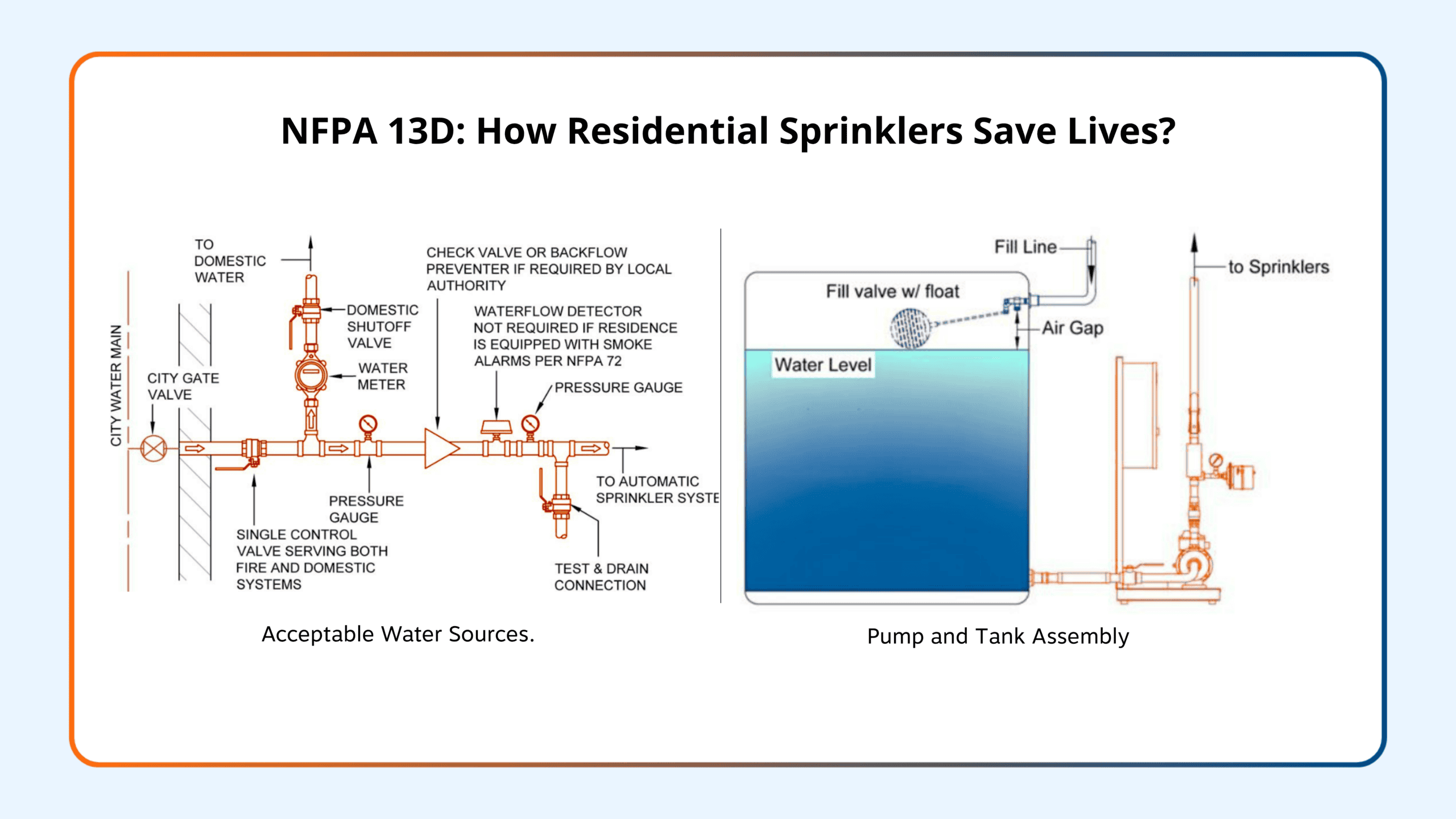
Acceptable Water Sources.
Domestic water supply is most common. The sprinkler system connects to the same pipe as residential plumbing.

Well Systems: Allowed if the pump and pressure meet the system’s requirements. If not, a storage tank and booster pump may be necessary.
Storage tanks are used when the primary supply becomes unstable or unavailable. Tank size is determined by system demand, like 260 gallons for 26 GPM over 10 minutes.

Combination Systems: Some residences employ a tank fed by a well, with a separate sprinkler pump.
Key Design Considerations:
Flow Rate: At least two sprinklers must operate at the same time, for a total flow rate of 13-26 GPM.
Pressure: Must fulfil the sprinkler heads’ minimum pressure requirements, taking into account elevation and friction loss.
No Fire Department Connection is Required: Unlike NFPA 13 systems, 13D does not require a fire department connection.
No NFPA 20/22 Compliance Required: Pumps and tanks used in 13D systems are not required to fulfil the tougher standards of NFPA 20 (pumps) or NFPA 22 (tanks).
Testing and Verification
A flow test is necessary to ensure that the water source can meet the system’s hydraulic requirements.
When operating a well, it is critical to document pump capacity and tank contents accurately.
Summary
NFPA 13D systems are a simple and cheap way to keep people safe from fire in homes. These systems are made just for single-family homes and duplexes, with design criteria that put safety first and make it easy to get out and put out fires quickly. NFPA 13D systems use fewer sprinklers, less water flow, and are easier to install than NFPA 13 or 13R commercial systems.
NFPA 13D does not require fire department connections or complete compliance with NFPA 20 and NFPA 22 for tanks and pumps. The rules for water supply are likewise less strict. Depending on the size and structure of the residence, they just need to sustain 7 to 10 minutes of sprinkler activation. This makes it possible to connect to existing plumbing systems in homes, or to use wells, storage tanks, and booster pumps when needed.
Planning and design, getting permits, installing the system, testing it, and teaching the owner how to use it are all important steps in implementing a system. It’s important to do flow tests and inspections to make sure the system works in an emergency.
The main goal of NFPA 13D is to save lives. This guideline is an important step towards keeping our homes safer because studies show that having sprinklers and smoke alarms can cut the number of deaths in home fires by up to 80%.
Courtesy : Jennifer