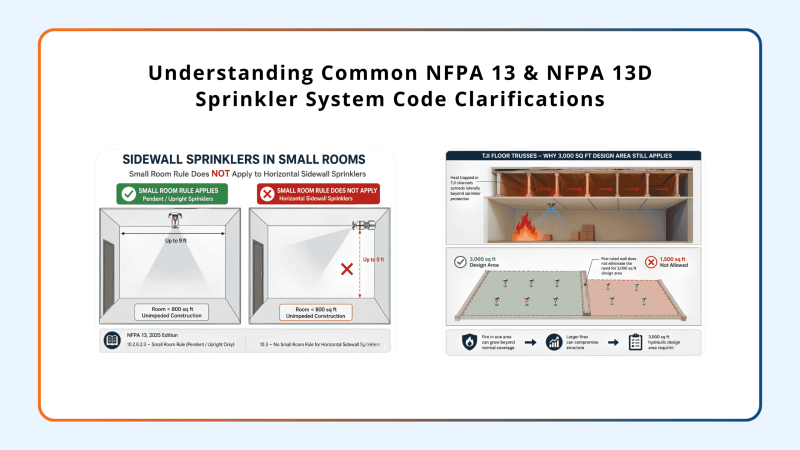
Understanding Common NFPA 13 & NFPA 13D Sprinkler System Code Clarifications

In relation to low-piled and assorted storage, what does NFPA 13 describe as “storage”? The 11th edition of Merriam-Webster’s Collegiate Dictionary is cited in Sections 3.1.2 and 3.1.3 of NFPA 13, 2025 edition, for the commonly recognised definition of terms that are not defined in the standard. “Store” is defined by Merriam-Webster as 1. to […]
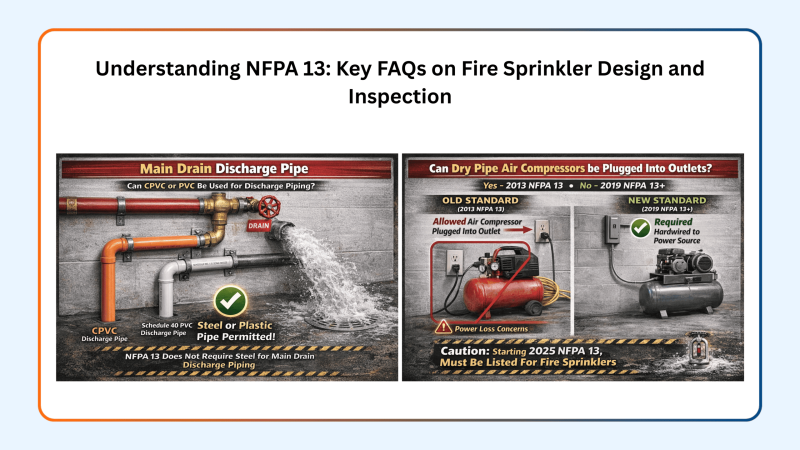
Understanding NFPA 13: Key FAQs on Fire Sprinkler Design and Inspection

Comprehensive regulations and standards provide direction for a variety of fire prevention systems; however, there are often practical challenges to implementing them in real applications. NFPA 13, NFPA 20 and NFPA 25 provide instructions for the design, installation, and maintenance of fire sprinkler systems. As a result, all too often engineers, contractors and building owners […]
Fire Protection Changes in 2026: Inspection, Testing & Compliance Explained

An important proposed revision would mandate annual internal inspections on all preaction and deluge valves instead of the current five years. This shift is in line with continuing reliability issues for these types of systems, and will cause more frequent ITMs and consume related labor hours. Quarterly testing is now required on solenoid-operated releasing devices […]
Fire Protection Q&A: Pumps, Sprinklers, Design & Code Compliance Explained

Description: We are receiving AHJ feedback on a certain component that is FM approved but lacks a UL listing. The AHJ states that this component cannot be used in an NFPA 13, 2019 edition system because it is only FM approved. Question #1. Does an FM Approval meet NFPA 13, Section 7.1.1.1 and include evidence […]
Critical Fire System Identification Requirements

Signage is typically not the first thing that comes to mind when considering sprinkler ITM. However, signs make it easier for facility employees and emergency responders to find important parts and run the system in an emergency. The difficulty? One of the most misinterpreted aspects of NFPA 25 inspections is signage. Inspectors frequently point out […]
Reliable Foam Protection Systems for Petrochemical Tank Storage Facilities

Tank farms are oil and petrochemical product storage facilities that contain large amounts of fuel and vapour that can cause serious fire safety hazards. Firefighting foam is still the most effective way to extinguish fires in these facilities because it cools burning fuel, suppresses vapors, and prevents the flames from coming back once the burning […]
Sprinkler Standpipe Technical Q& A

Question 1: Different pressure requirements are listed for different hose assembly configurations in NFPA 14, 2024 edition Table A.10.2.6. Does the minimum pressure needed at the hose connections for the relevant hose assembly configuration correspond to the “outlet pressure” in the table? Is 11.1 bar of pressure too much for a combined fog nozzle, if […]
The Future of Fire Protection: Breakthrough Solutions That Didn’t Exist a Decade Ago

Summary: Over the last 10 years, the fire protection industry has changed rapidly, resulting from stronger codes; new hazardous materials; and best practices in data-driven equipment. Among some of the most notable innovations are remote inspections for ITM, digital ITM reporting, transitions to PFAS-free foam, and lithium-ion safety standards. Each of these innovations has dramatically […]
Practical NFPA Guidance on Fire Protection Design, Testing, and Compliance

Summary: This TechNotes gives clear, practical clarity on frequently asked fire prevention topics about NFPA 13, NFPA 24, and NFPA 25. This resource is intended for engineers, contractors, inspectors, and facility owners. It tackles real-world circumstances that frequently cause misunderstanding during the design, installation, testing, and maintenance of water-based fire protection systems. The blog […]
Residential Sprinkler Exemptions and Fire Performance (2020–2024)

Residential fire sprinkler guidelines have historically exempted certain parts of dwellings from sprinkler protection. These exemptions, established under NFPA 13D and NFPA 13R, were initially justified by historical fire loss statistics indicating a low frequency of fires and fire-related fatalities in certain areas such as small bathrooms, closets, attics, and outdoor spaces. However, residential construction […]